Hazardous materials transportation
The transportation of hazardous materials and goods means anything that may pose a danger to humans, animals or the environment. This includes everything from fireworks, chemicals, batteries, paint and oil products. Logically, there are strict requirements associated with the transportation of hazardous materials. In this article, we will discuss the different types of hazardous materials and the laws and regulations. If you wish to transport hazardous materials, we recommend doing your homework properly. That is, make sure you know what regulations you need to comply with for packaging and go with a qualified company that has the proper paperwork.
We are happy to put you in touch with reliable and qualified hazardous materials carriers. Consult our business directory or request multiple quotes directly from affiliated companies.
Feed dangerous substances and goods legislation
In the Netherlands, the rules for the transport of dangerous goods are contained in the Transport of Dangerous Goods Act (WVGS). This contains the additional measures that apply in the Netherlands in addition to the European rules. The WVGS consists of:
- Regulation on the land transport of hazardous substances (VLG) supplementing European Accord relatif au transport des marchandises dangereuses par route(ADR)
- The Regulation on the Transport by Rail of Dangerous Goods (VSG) as a supplement to the European Règlement concernant le transport international ferroviaire des marchandises dangereuses(RID)
- Regulation on the Transport by Inland Waterways of Dangerous Goods (VBG) supplementing the European Accord européen relatif au transport international des marchandises Dangereuses par voies de Navigation intérieures (ADN)
| Soort transport | Europese wetgeving | Aanvullende Nederlandse wetgeving |
|---|---|---|
| Wegtransport | ADR (PDF) | VLG (link naar de wet) |
| Spoortransport | RID (PDF) | VSG (link naar de wet) |
| Watertransport | ADN (PDF) | VBG (link naar de wet) |
If you take a quick look at the legislation, you will see that it is very extensive. Fortunately, the right transportation company can usually help you what is necessary to transport the your hazardous materials.
Types of hazardous substances, classification and numbers
ADR hazard classes
Hazardous materials are divided into nine different classes (and subclasses), which are the ADR hazard classes. Associated with these classes is a label (hazard label). This label is mandatory for road transport.
The nine main classes are: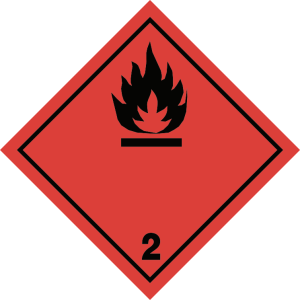
- Explosive substances and objects
- Gases
- Flammable liquids
- Combustible solids
- Oxidizing substances
- Toxic and infectious substances
- Radioactive substances
- Corrosive substances
- Miscellaneous hazardous materials
You can expand the table below for all subclasses and their corresponding label.


Hazard identification number (GEVI) and United nations substance identification number (UN number)

In addition to the ADR hazard classes, there is the hazard identification number (GEVI). This number indicates not only the class but also the degree of hazard. The first number always corresponds to the ADR hazard class. If the second number is the same as the first number it indicates that the hazard is greater. For example, 30 indicates a flammable liquid and 33 indicates a highly flammable substance. The GEVI number should always be on an orange label in conjunction with the United Nations substance identification number (UN number). Here, the GEVI number is always above the line and the UN number below the line. There is a separate UN number for each hazardous substance, which always consists of 4 digits. In practice, this means that there are thousands of UN numbers. For gasoline, for example, this is 1203. If you unfold the table below you will see an overview of the possible GEVI numbers.
There are very many different UN numbers, also called substance identification numbers. Each UN number is linked to a GEVI number. Our database of UN numbers contains all UN numbers and their associated GEVI numbers. You can also find this substance in the RIVM database.
Certificates
In the Netherlands, certificates are issued by the CBR for drivers and for so-called safety advisors. See below the explanation of what these certificates entail.
ADR certificates for drivers
For drivers, there is the ADR basic certificate. Drivers who transport dangerous goods by road must have this certificate. This certificate is valid for 5 years and is issued by the CBR. To obtain this certificate, a training must first be followed at an ADR trainer recognized by the CBR . Some hazardous materials require an addition to the basic certificate. For example, there is the ADR certificate specialization transport class 1 (Explosive substances and objects) and the ADR certificate specialization transport class 7 (Radioactive substances). In addition, there is an ADR certificate specialization transport in tanks. The driver transporting the hazardous materials must hold the necessary certificates.
ADR certificates for safety advisors
Companies engaged in transporting hazardous materials should also employ or hire a safety advisor. Safety consultants can also be hired by, for example, the company that needs to package the goods. The CBR issues the following certifications: Road Safety Advisor Certificate, Inland Waterway Safety Advisor Certificate and Rail Safety Advisor Certificate.
The right transportation company to transport hazardous materials
To find the right company to transport your dangerous goods, take the following steps. First, look up the ADR number, GEVI number and UN number of the substance you want to transport. Often the product or good has an accompanying hazard sheet. This is sometimes included in the packaging or can be found online. If you cannot find it here you can always contact the supplier. You ensure that you comply with the packaging requirements of the hazardous substance. You also always check this with an ADR advisor or the specialized transport company. Look up the substance in question in our database of UN numbers. Then see if there are any specific packaging requirements. You then look up these packaging requirements in the ADR legislation.
Requirements for dangerous goods transportation company
Next, you need to find a carrier who can perform this transportation. The following requirements apply:
- The vehicle transporting hazardous materials needs a MOT inspection certificate or a certificate of approval and vehicle equipment.
- The driver must hold a certificate of professional competence. This is also known as an ADR certificate.
- The driver must be medically approved.
- Written instructions must be present in the vehicle cabin (the hazard card). This hazard card must be in the language of the country of sender, transit and destination of the substances.
- The driver must be aware of the hazards and characteristics of the substance.
- Procedures should be followed
For more information, visit the arboportal site.
Check the above points before engaging with the transportation company. Unfortunately, in practice, it happens too often that transporters accept an order while not meeting the above requirements. Therefore, always check the specialty of the company, ask about the experience they have and check the ADR certificate. Do this even after you have placed an application with us. Always look up the company in our business directory, and check there if the company has the permits and the ADR certificate (this is verified by us). Always check with the company if they employ an ADR consultant. Discuss packaging and transportation with this advisor.
An example of transporting hazardous materials: sending batteries
Suppose you want to ship some VMF brand lead-acid batteries from Aalsmeer to Sneek (road transport). You realize that lead acid batteries fall under dangerous goods. You go to the supplier's website and you find this safety sheet. In this hazard sheet you find that the batteries fall under ADR class 8, have the GEVI number 80 and the UN number is 2800. You look this up in our database of UN numbers. Here you will find packaging instructions P003 and P801a and special provision packaging PP16. You look these up in the ADR legislation. Here you will find packing instruction P003 on page 50, packing instruction P801a on page 150 and special provision PP16 on page 51. You check all of these and make sure that the batteries are packed correctly.
You then place a request on this site. In this request you mention the ADR class found, the GEVI number and the UN number. You will receive some responses from affiliated companies. You look up each company in the company directory to perform a check on the ADR certificate there. You contact a company where the ADR certificate has been verified by us. You inquire about the experience and ask if the company is aware of the hazards of the substance. You discuss with this company whether the packaging is adequate.
We strongly recommend a careful approach to transporting dangerous goods. You can also always hire an ADR safety consultant yourself to help with your transportation request.
Offers from hazardous materials carriers?
Request multiple quotes without obligation from affiliated transport companies that can transport ADR substances. Fill out the form without obligation and companies will contact you.
Transport companies with an ADR certificate


Previously transported dangerous goods
Offers from Hazardous Materials Transporters?
Request non-binding quotes from affiliated transport companies that can transport ADR substances